Review: Rival Stars Horse Racing

Developer: PikPok
Publisher: Prodigy Design Limited T/A Sidhe Interactive
Genre: Management, Sports
Price: FREE (Micro-transactions)

Ever since I played The Legacy of Rosemond Hill, I have been on a seemingly hopeless search for a game that can measure up to it. I want a little bit of stable management, horse management, mystery, competitions, and character story/development. Alas, I have found nothing and Rival Stars Horse Racing is not quite there either… but almost.

Your family is a well known horse racing family but due to a fatal tragedy you have all given up the horse business, that is until now. A manager of the stable pleads to you, saying he still believes in your legacy and requests that you come back which you of course do with the option of choosing your own gender, ethnicity, name, and racing gear.

After confirming your identity you are tasked with facility and horse maintanence and upkeep. Your first order of business is to get a horse because without it you cannot race and earn the money you need to evolve your ranch. You get the option to name it, however, there are a few restrictions to the naming if you want the commentators to shout out the horse name during races. The randomize button gives a few opportunites for giggles as the two-word name suggestions can turn out ‘Free Flattery’ and ‘Complete Goat’.

Rival Stars Horse Racing is a good mixture of management, competition, and play. You get to breed your horses for the best possible stats, train them, race with them in races against other players or AI, and even save pictures of your best horse. It does have a story, but it fails to capture my interest as it seems to be the staff around the ranch simply telling some tidbits about themselves or what they think you should do. I would have loved if the player had been involve and active within the story as they are completley left out of it as it stands at the moment.

Despite the lack of story, Rival Stars Horse Racing is the best game out there if you want a game with horses. It is a good managment game, but what sells it is the polished graphics and a well done horse niche. However, if you are into racing and managment games I would give this one a try to see if you can breed and train the best racing horse there ever was.

The Social Gaming Platform

Mobile gaming is often said to never surpass or even be near gaming on the more established platforms such as Playstation, Nintendo Switch, and PC. However, in some areas gaming on mobile is better.

The mobile easily surpasses all the above mentioned when it comes to social gaming. Despite having multiplayer both locally and online they do not have the most important key ingredient which is accessibility. Every other person, or you could say most, have a mobile phone. If you have a mobile phone you have access to a great selection of the games that can be played on it and most of those games have social aspects, if they are not already tailored around it.

It might be annoying to have the game always ask you to add friends or to get access to your contacts, but that being annoying proves how social the game is. It reminds you to add friends for its profit but also for your, the player’s, benefit. It might seem small, but sharing your creations, journeys, and achievements with friends provides enough fodder for conversation and play to fuel a good relationship with another human.

This does not come as easily with other platforms. Friends and family much first purchase the gaming platform and whichever game they want to, or have been asked to, play. On top of this, some of the other gaming platforms also require you to pay a fee to play online on their servers. Measuring this to that of mobile gaming makes it a lot more expensive and demanding to play locally and/or online.

If you are mostly interested in playing with your friends then, believe it or not, mobile gaming might be the best way.

Why Mobile Games are bad

If you ask the average gamer to list the consoles on which they play games there is a very, very big chance that they won’t even think of their phone as a legitimate gaming console. The reason? There just are no legitimate games on mobile.

Mobile games are short, pay to play, a waiting game, and wants to know all your contacts or access your camera. Not all games, but most you will find do tick all the above mentioned. There is a constant reminder to ‘invite your friends’ or to log in with facebook to access this feature, or ‘for only £10 you can be the owner of this legendary weapon’. In worst case, ‘let us access your camera to store photos of you, your surroundings, and your friends… maybe even your cat!’.

Gamers are used to a different scene. One that is not necessarily overly social, one that does not push all these notification onto you, and also one that do not ask you to pay more than the initial price to play the whole game. The race for gamers attention, for anyone’s attention, is insane and stressful. Gaming is most of the time a stress relief and mobile gaming is definitely not that.

Why mobile games are bad is not tied to the games themselves not really, it is more tied to how they are executed. The very core of most of these games are just money grabs in fancy costumes or a sneak peak on what might have been a good full game if released on another console which do not promote the same kind of ‘bursts’ of playtime. The players do not blame the games, but the developers execution of them.

The very reason for this blog is to find the good among the forest of the bad. Because there are games, and developers, who have used this platform and created games that suit it without disappointing their players. Those are the ones who are worthy of our time, not the ones who keep asking us to pay another £20 for that cool armour or alert us with a notification every other hour asking if we are still there because no, no we are not, we are playing other games bye bye delete.

Review: Pocket Build

Developer: MoonBear LTD
Publisher: MoonBear LTD
Genre: Fantasy, Sandbox Builder
Price: £1.99

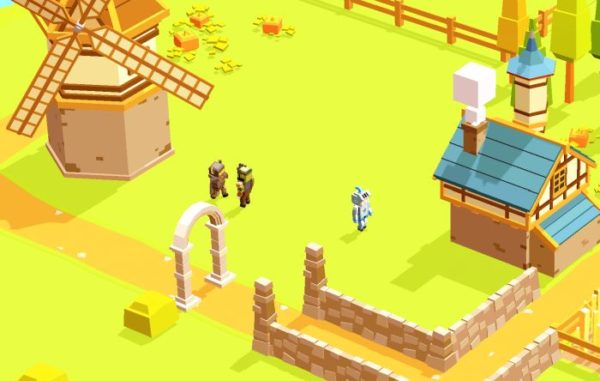
To create your own fantasy world and fill it with monsters, royalty, and NPCs is something I have always found interesting. When I found Pocket Build for only £1.99 I did not hesitate. It had the charm of a blocky, yet cute, aesthetic and the possibilities that comes with such a style. Daunting at first, the world I created began as a humble island which became the home to a witch, some forest animals, and her apprentice.

To create your own fantasy world and fill it with monsters, royalty, and NPCs is something I have always found interesting. When I found Pocket Build for only £1.99 I did not hesitate. It had the charm of a blocky, yet cute, aesthetic and the possibilities that comes with such a style. Daunting at first, the world I created began as a humble island which became the home to a witch, some forest animals, and her apprentice.

Pocket Build gives you the tools to create your vision of a fantasy village, an orcish den, or a princess’s castle; or why not all of those in one world? You can choose from the starting point of basic squares of land — each with a different biome. You can stack the squares or put them next to each other to fashion an island. The next step would be to make the squares less empty. In the tools menu, the player can choose to put down trees, rocks, plants, houses, fences, market stalls, crops, castle walls, villagers, or dogs. My only complaint is that so far there are no cats.

When done, you can share your world with other players but except for inspecting and surveying the worlds there is little else that can be done.

One progressive element that was added was the food, gold, and lumber counter. Some cool looking buildings or gruesome plants cost food, or lumber, or gold, or maybe a combination of two. You get food and lumber from your NPCs harvesting certain things and gold you receive from harvesting gold piles.

You can make a battle arena by sticking NPCs of a lighter alignment with NPCs of a darker alignment together and wait out the imminent result. It is not a very satisfying thing to watch, but it might provide some contentment to a player’s need to watch things die.

Pocket Build is not a progression game, it is more of a fantasy sandbox builder where the player sets the rules. There are no waiting times for building and the developers rely on player donations. I would advise to donate a small amount should you enjoy the game because Pocket Build receives good additions in patches from time to time, evolving and developing as time goes by instead of slowly turning into ash, like some games.

Review: Tapsonic TOP

Developer: Neowiz Games
Publisher: Neowiz Games
Genre: Music
Price: FREE

Ever wanted to be a Music Producer? In Tapsonic TOP you can. Starting off with a humble cast of musical talents you are set out on an adventure to create the best possible line up and get the best high scores on several different songs available for free, mostly.

The gameplay in Tapsonic TOP is to ‘score points by tapping the screen as the notes appear with rhythm and beat.’ To maximise this score it is vital to choose the right stars for the song. Stars are divided into three categories: Vocal, Dancer, and Session. Within those categories are subcategories, which can be considered as specialisations, such as Tap Note, Slide Note, and Flick Note. Finding the right cast can be fun and if not for the higher score then for trying to make a viable group out of the many different stars to choose from. I have sacrificed score for a cute cat star several times.

As a producer it is up to the player to level up, train, rank up, and awaken the stars. This can be done by sacrificing another star, put a star on a schedule using staff, or use the star when playing a song. The better the star, the better the score.

Aside from simply playing songs on different levels ranging from easy to expert, the player can test their mettle against other producers in the Music Grand Prix where a set of songs get available each day of the week and by the end producers get their total score measured against each other. Everyone is a winner at the Music Gand Prix, but the prize gets drastically reduced the further a producer’s placing is from the top. It is a simple, yet nice way to test yourself against other players and see if you can tap as good as you think.

The songs may be of varying quality; some are good, some are bad, some are annoying, some are catchy. However, the gameplay is rewarding and fun which have made the most annoying song bearable to sit through if it shows up in the Music Grand Prix a Monday morning. The songs are challenging enough and the difficulty levels available provide ample room to learn. Sometimes the expert option felt too easy or too difficult, but that was mostly in regards to the general difficulty of the song

The initial pricing of the game is free, though the game allows for micro transaction to gain stars and staff. It is not, however, required to access and play the game. The player can happily play through all content and see most of it without making a single transaction.

If you love music games and cannot ever get enough of cute, quirky anime characters then Tapsonic TOP is definitely a game for you. However, if you are looking for an amazing music journey with a fantastic story then I would advise you to move on as the little story that exists in the game is beyond rescue.

Review: Tsuki Adventure

Developers: HyperBeard Games
Producers: HyperBeard Games LLC
Genre: Family, Calm
Price: FREE

Tsuki (Moon in Japanese) is a rabbit who moves to a small village to become a carrot farmer. The village is calm with slow moving villagers who enjoy the days as they come and go. Tsuki has some old friends in this village but can also make a few new ones. It is the player’s choice to interact with the villagers and slowly build up a relationship in form of a heart colour. With each small conversation the colour comes closer to red and an opportunity to earn a special item.

The game tells the player early on that Tsuki is not a pet, Tsuki will live however a rabbit sees fit without the players constant watch. The things the player can affect is who Tsuki talks to and what items Tsuki use as well as when to farm the massive carrot in the backyard. Doing any of the mentioned can change scenery, allow interaction with new characters, or new interactions with old, and make more items available for Tsuki. Overall, it could be said that the goal of Tsuki Adventure is to collect memories.

If a calm, almost tranquil, experience is what you are after Tsuki Adventure surely delivers. The game is not like having a pet that constantly demands attention but more like reading a story about the adventures of a rabbit in a small village that will forever be the same no matter how little, or much, time you spend on the game. It is a comforting escape from a hectic life.